
The Digital Thread Is Changing Precision Manufacturing: What OEMs Should Expect
Precision manufacturing has always been about making the part right. In 2026, that’s only part of the equation.
Aerospace, defense, energy, medical, and other demanding industries increasingly need manufacturing partners that can also manage the data surrounding the part—from the original engineering model and machining process to inspection results, quality documentation, and final delivery.
This connected flow of information is commonly called the digital thread, and it is becoming an increasingly important part of advanced manufacturing.
What Is the Digital Thread in Manufacturing?
The digital thread connects information throughout a product’s lifecycle instead of allowing engineering, production, inspection, and supply-chain data to exist in separate silos.
The National Institute of Standards and Technology (NIST) describes digital-thread technology as a way of connecting product design with manufacturing and quality activities while allowing manufacturing and inspection information to flow back into engineering.
Source: NIST — Digital Thread for Manufacturing
For a precision machining operation, that can mean creating a more continuous connection between:
CAD models and engineering specifications
CAM programming
CNC machining operations
Product and manufacturing information
CMM inspection and metrology
First-article inspection
Quality records
Traceability and production documentation
The goal isn’t simply to collect more data. It’s to make manufacturing information more useful, accessible, and consistent from drawing to finished component.
Why This Matters for Aerospace and Defense Manufacturing
Digital manufacturing is particularly relevant to aerospace and defense, where complex components, tight tolerances, documentation, traceability, and supplier coordination are part of everyday production.
A NIST-supported roadmap specifically identified aerospace and defense as one of the sectors where digital-thread technology can help strengthen manufacturing supply-chain resilience and capacity.
Source: NIST — Roadmap to Strengthen the U.S. Manufacturing Supply Chain via Digital Thread Technology
That makes the capabilities of the machining supplier increasingly important.
An OEM doesn’t just need a vendor capable of holding a tolerance. It needs a manufacturing partner capable of maintaining process control, verifying the result, documenting it, and communicating effectively when requirements change.
AI Is Entering the Manufacturing Equation
Another major development in 2026 is the continued integration of artificial intelligence and machine learning into manufacturing.
In July 2026, NIST published its 2026 Roadmap on Artificial Intelligence and Machine Learning for Smart Manufacturing. The roadmap highlights applications including advanced sensing, industrial data analytics, autonomous systems, digital twins, robotics, supply-chain optimization, and data-centric metrology.
Source: NIST — 2026 Roadmap on AI and Machine Learning for Smart Manufacturing
For precision manufacturers, the opportunity isn’t about replacing machinists, programmers, or quality professionals.
It’s about giving skilled teams better information.
Over time, smarter manufacturing systems can help identify process variation earlier, analyze production data faster, improve scheduling, support predictive maintenance, and create stronger connections between machining and inspection.
Digital Twins Are Moving Forward, Too
Digital twins are another important piece of this transformation.
A digital twin is a digital representation connected to a physical product, process, or system. In manufacturing, digital twins have the potential to help companies evaluate and optimize production before problems reach the finished component.
NIST’s July 2026 Digital Twins Workshops Summary Report highlighted their potential to improve design, production, and lifecycle management, while also identifying challenges involving interoperability, cybersecurity, verification, validation, and workforce readiness.
Source: NIST — Digital Twins Workshops Summary Report
That distinction is important. New technology doesn’t eliminate the fundamentals of manufacturing. It makes those fundamentals even more important.
The Foundation Is Still Precision and Process Control
For all the attention being given to AI, digital twins, automation, and connected factories, none of these technologies compensate for poor machining processes.
The foundation still includes:
Capable equipment. Multi-axis CNC turning and milling can reduce setups and produce complex features with greater process consistency.
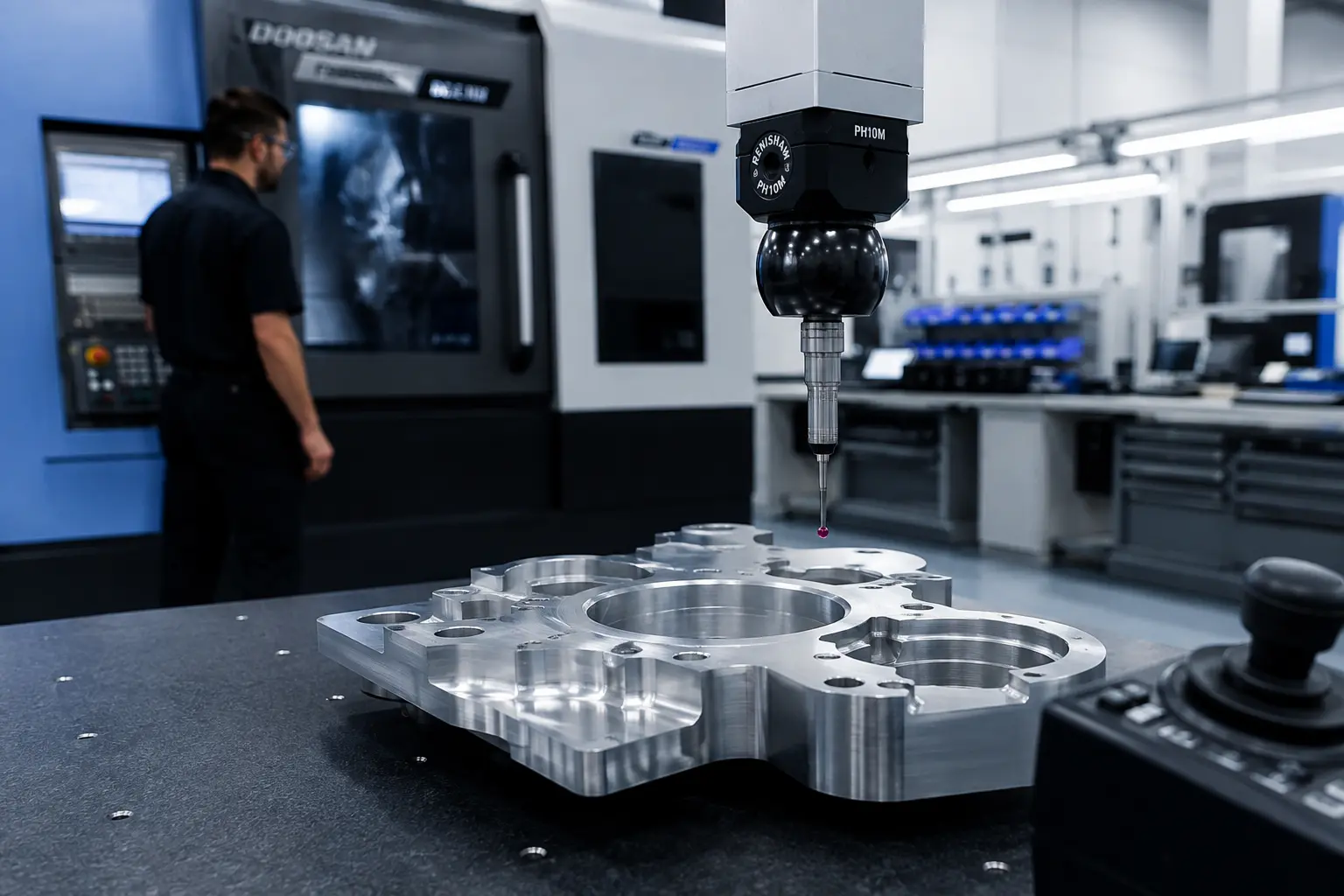
Inspection. In-house CMM inspection provides measurable verification that manufactured components conform to requirements.
Manufacturability expertise. DFM review can identify potential production problems before they become expensive problems on the shop floor.
Quality systems. For regulated industries, documented processes, first-article inspection, traceability, and quality standards remain critical.
Experienced people. Technology works best when experienced machinists, programmers, engineers, and quality professionals know how to apply it.
What OEMs Should Look for in a Precision Machining Partner
As manufacturing becomes more connected, supplier evaluation should go beyond asking, “Can you machine this part?”
OEMs should also consider whether a prospective supplier can efficiently move a component from engineering through production and inspection.
Can the manufacturer handle complex turning and milling operations? Does it have in-house metrology capabilities? Can it provide documented inspection results? Does it understand first-article requirements? Can it help identify manufacturability issues before production begins?
Those capabilities help create the foundation for the more connected manufacturing environment taking shape across American industry.
Precision Manufacturing Is Becoming More Connected
The future of CNC machining isn’t purely digital, and it isn’t purely mechanical. It’s the combination of both.
Machines will become smarter. Production data will become more connected. AI will provide new ways to analyze manufacturing processes. Digital twins will continue to evolve. OEMs will expect greater visibility throughout their supply chains.
But the objective remains familiar: make accurate, repeatable components and deliver them with confidence.
At Gemco Manufacturing, nearly six decades of precision manufacturing experience is backed by multi-axis CNC turning and milling, advanced milling, in-house CMM inspection and metrology, first-article inspection, DFM support, and managed secondary operations.
As manufacturing technology evolves, that combination of precision, inspection, documentation, and experience provides the foundation needed to keep moving forward.
Need a precision machining partner for your next project? Contact Gemco Manufacturing to discuss your drawings, tolerances, materials, and production requirements.
About Gemco
Precision CNC turning and milling for oil & gas, aerospace, defense, medical, and industrial customers, handling jobs complete since 1967.